




When choosing socket tools for your product line, one of the most common questions is:
Should you stock impact sockets or chrome sockets?
While both types may look similar, they are designed for completely different applications. Understanding their differences can help distributors and importers make better purchasing decisions and avoid costly mistakes.
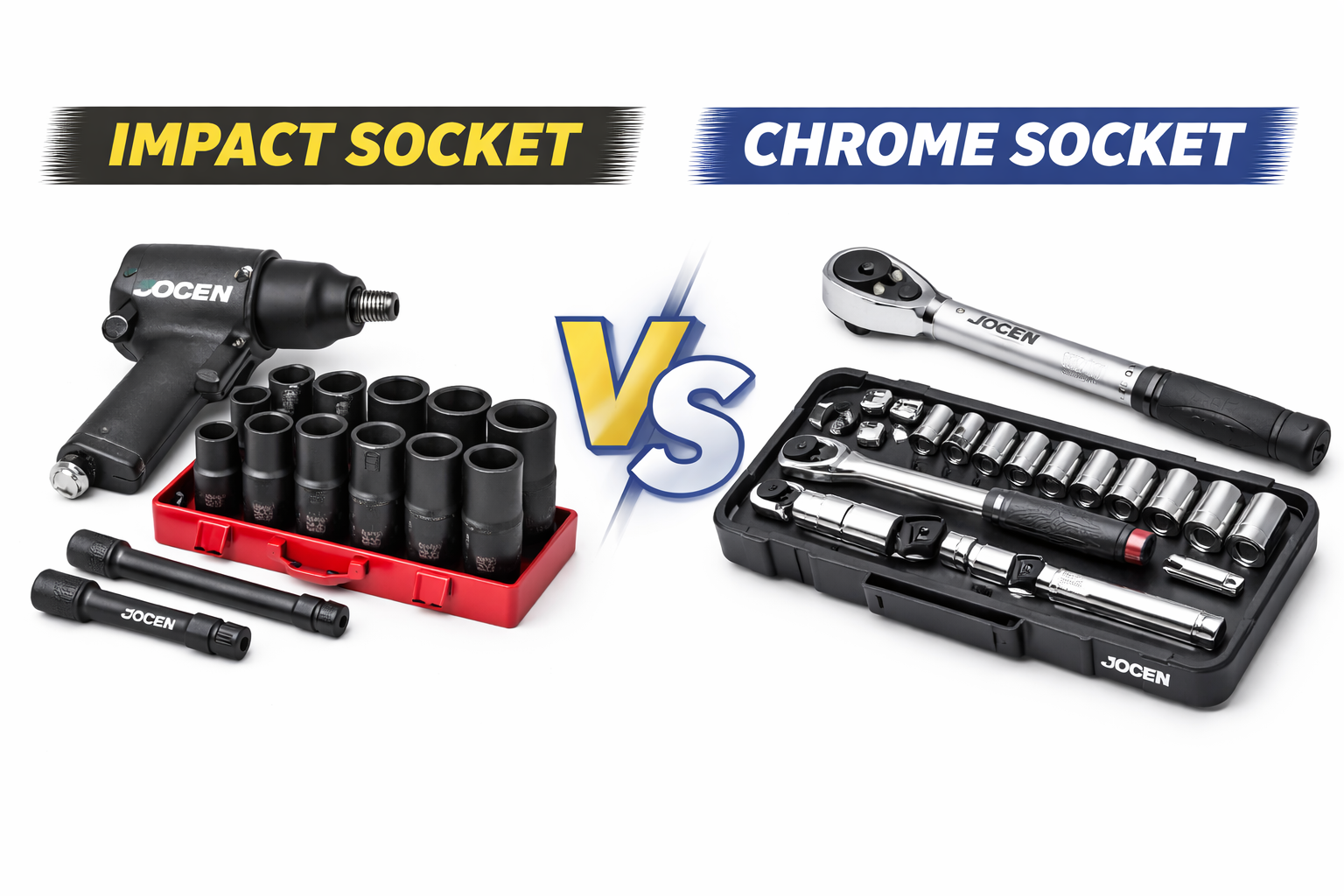
1. What Is an Impact Socket?
Impact sockets are specifically designed for use with impact wrenches and power tools.
They are typically made from Chrome Molybdenum (CR-MO) steel, which offers higher toughness and flexibility under stress.
Key features:
- Thick wall design to absorb impact force
- Black oxide finish (no chrome plating)
- Higher resistance to cracking under shock load
- Designed for repeated high torque applications
Ideal for:
- Tire service
- Truck maintenance
- Industrial repair
2. What Is a Chrome Socket?
Chrome sockets (also called hand sockets) are designed for manual tools such as ratchets and torque wrenches.
They are usually made from Chrome Vanadium (CR-V) steel, which is harder and more wear-resistant.
Key features:
- Thin wall for tight spaces
- Mirror chrome finish (anti-rust)
- Higher hardness but more brittle
- Designed for steady torque, not impact
Ideal for:
- Engine work
- Precision assembly
- Light to medium-duty repair
3. Impact Socket vs Chrome Socket: Key Differences
| Feature | Impact Socket | Chrome Socket |
|---|---|---|
| Material | CR-MO | CR-V |
| Hardness | Lower (more flexible) | Higher (more rigid) |
| Wall thickness | Thick | Thin |
| Finish | Black oxide | Chrome plated |
| Application | Impact tools | Hand tools |
| Durability under shock | Excellent | Poor |
The key difference:
- Impact sockets = toughness (won’t break)
- Chrome sockets = hardness (won’t wear easily)
4. Safety Difference (Very Important)
Using the wrong socket can be dangerous.
- Chrome sockets may crack or shatter under impact force
- Impact sockets are designed to absorb shock instead of breaking
This is why:
Chrome sockets should NEVER be used with impact wrenches
5. Which One Should You Stock? (For Distributors)
This is the most important part
If your customers are:
- Auto repair shops
- Tire service centers
- Heavy-duty workshops
You should focus on impact sockets
Because:
- Higher demand in modern workshops
- Compatible with power tools
- Lower breakage rate = better reputation
If your customers are:
- DIY users
- Light repair workshops
- Precision mechanics
You should stock chrome sockets
Because:
- Lower cost
- Better for tight spaces
- Suitable for hand tools
Best Strategy (Recommended)
Instead of choosing one, the best solution is:
Stock both, but prioritize impact sockets
Why:
- Impact sockets cover more applications
- Can also be used with hand tools
- Growing demand with power tools
6. Cost vs Profit Consideration
From a business perspective:
| Type | Cost | Durability | Customer Demand |
|---|---|---|---|
| Impact Socket | Higher | Higher | Growing |
| Chrome Socket | Lower | Medium | Stable |
Insight:
- Impact sockets = long-term value
- Chrome sockets = entry-level market
7. Final Recommendation
If you are building or expanding your tool product line:
Start with:
- Impact socket sets (main product)
- Add chrome socket sets (supplement)
This combination allows you to:
- Cover more customer segments
- Increase order value
- Stay competitive in global markets
Looking for a Reliable Socket Supplier?
At JOCEN TOOLS, we offer:
- Full range of impact & chrome socket sets
- Stable quality with competitive pricing
- OEM & private label solutions
If you are looking to expand your socket product line, feel free to contact us for more information.
Conclusion
Impact sockets and chrome sockets serve different purposes, and neither replaces the other.
For distributors, the key is not choosing one — but building the right product mix based on your market needs.
Post time: Apr-20-2026